What an EICR is and who needs one
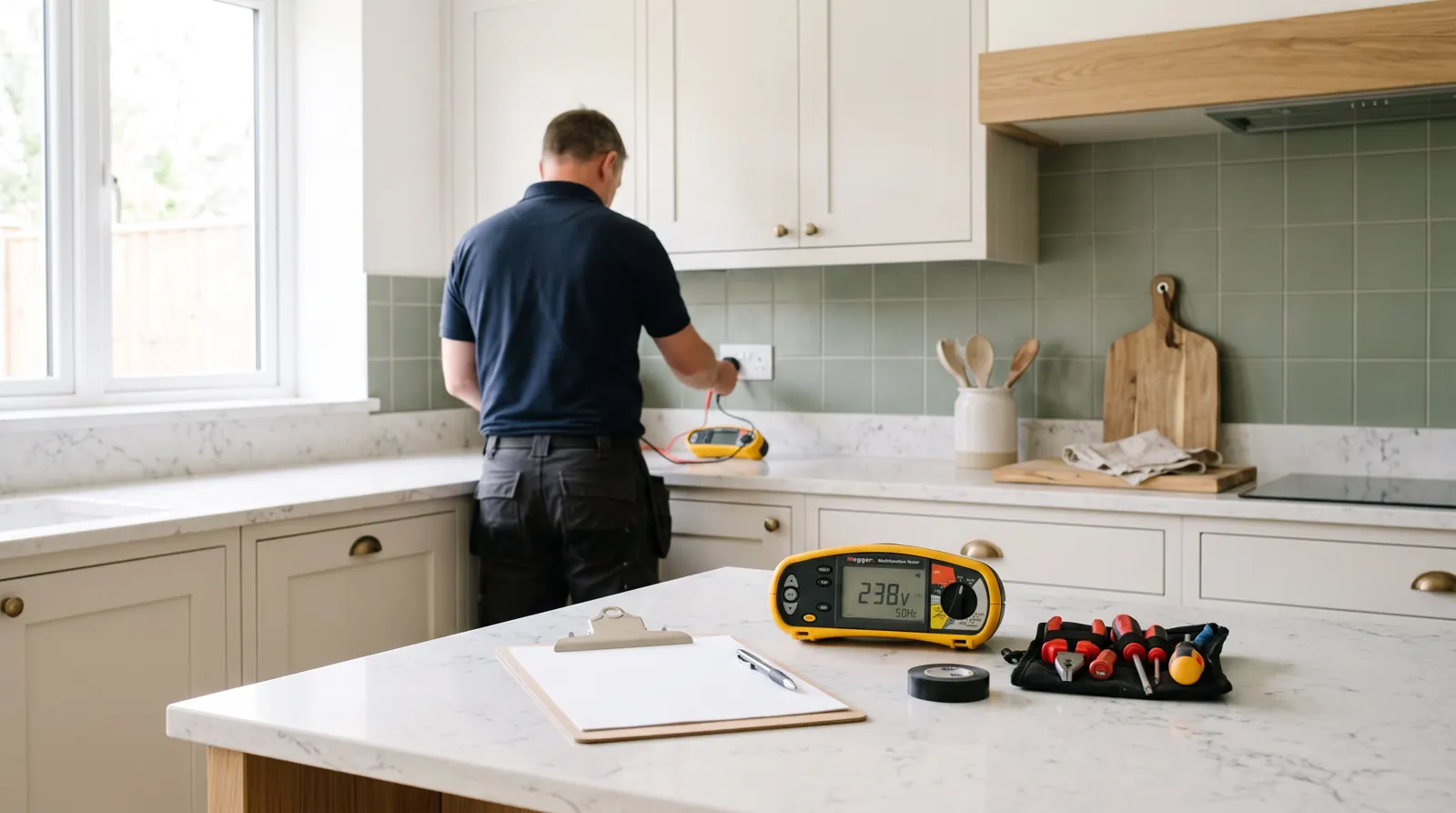
The inspection covers the parts of your electrics you never see: the fuse box (consumer unit), the cables behind the plaster, the earthing, and every socket, switch and light fitting. We test each circuit with calibrated instruments and record its condition against BS 7671, the IET Wiring Regulations, 18th Edition.
It is a report, not a repair. The document says whether the installation is satisfactory or unsatisfactory, lists each defect with a code, and gives you the evidence to decide what to fix and when.
People who need one:
- Landlords letting a home in England, at least every 5 years and before a new tenancy starts.
- Anyone buying an older house, ideally before exchange, so the cost of any remedial work is known rather than discovered later.
- Homeowners who have never had the wiring checked. The usual guidance for an owner-occupied home is a report every 10 years.
- Businesses that need to show their fixed wiring is being maintained.
- Owners of licensed shared houses, where the council asks for a current report as a licence condition.
What an EICR costs
| Property | Price (inc. VAT) |
|---|---|
| Flat or house up to 3 bedrooms | £150–£250 |
| House with 4–5 bedrooms | £250–£350 |
| Landlord EICR for a rental | £150–£250 |
| Commercial EICR (fixed wire testing) | £30–£50 per circuit |
Where you land within the range depends on the number of circuits and how easy the consumer unit is to reach, and we confirm the exact figure in writing before we book you in. The price includes the inspection, the testing, the written report and VAT. Nothing is added on the day.
If the report turns up work that needs doing, we quote for it separately, and you are free to take the report to another electrician. Every price we charge is on the prices page.
Do landlords need an EICR?
Yes, if you let a home privately in England. The Electrical Safety Standards in the Private Rented Sector (England) Regulations 2020 require an EICR at least every 5 years, a copy to the tenant within 28 days, and any remedial work finished within 28 days of the report. The local authority can fine a landlord up to £40,000 for not complying.
Social housing came into scope more recently: new tenancies from 1 November 2025, existing tenancies from 1 May 2026, with a first inspection due by 1 November 2026. Social landlords must also check the appliances they supply every 5 years.
We keep a separate page for landlords and letting agents covering the deadlines, the paperwork and what to do after an unsatisfactory report: landlord electrical safety certificate. Shared houses with a licence have extra conditions, explained on our HMO electrical compliance page.
Do you need an EICR to sell your house?
No. No law says a house sale needs an EICR. Your buyer's surveyor will almost certainly recommend one, and a buyer's solicitor may ask whether one exists, which is why sellers of older houses often commission the report themselves.
Having the report before you list puts you in control. You know the true condition of the wiring, you can clear the C2 items before a buyer uses them to negotiate the price down, and the sale does not stall while somebody else arranges an electrician.
Do businesses need one?
There is no statutory interval for a commercial EICR. The legal duty comes from the Electricity at Work Regulations 1989, which require electrical systems to be maintained so as to prevent danger. The 5-year figure for offices and shops, 3 years for industrial premises and annual testing for some higher-risk sites all come from IET Guidance Note 3, and they are recommendations rather than law.
In practice your insurer, your landlord or your fire risk assessor will ask to see a current report, and a periodic EICR is the simplest way to show the 1989 duty is being met. We charge £30–£50 per circuit for fixed wire testing and can work outside your trading hours. Our commercial electrician page explains how we test occupied premises without shutting the business down.
What we check
The inspection has two halves: a visual survey of everything accessible, then instrument tests on every circuit. We look at:
- The consumer unit and protective devices: RCD, RCBO and MCB ratings, whether every circuit has RCD protection, signs of heat damage, and whether the enclosure is fit for purpose.
- Earthing and bonding: the main earth, the bonding to gas and water pipework, and whether the earthing arrangement suits the supply from UK Power Networks.
- Cable condition and insulation resistance: each circuit is tested to confirm the insulation has not broken down, which is how perished rubber and lead-sheathed cable gets caught.
- Sockets, switches and accessories: a sample of each, checked for polarity, earth continuity and physical condition.
- Signs of overheating, damage or DIY work: scorched sockets, joints hidden in ceiling voids, unfused spurs and cables run without protection.
We also record RCD trip times and earth fault loop impedance on every circuit. Those two tests tell us whether the protective devices would disconnect quickly enough if a fault developed.
What the codes mean
| Code | Meaning | Report result |
|---|---|---|
| C1 | Danger present, risk of injury. We make it safe before we leave | Unsatisfactory |
| C2 | Potentially dangerous. Needs remedial work soon | Unsatisfactory |
| C3 | Improvement recommended. Not dangerous | Satisfactory |
| FI | Further investigation needed without delay | Unsatisfactory |
A report is only satisfactory when it contains no C1, C2 or FI observations. C3 items are advice: worth doing, not compulsory. A lighting circuit with no RCD protection, for example, normally attracts a C3 on its own, whereas a bare live conductor behind a broken socket is a C1.
How long it takes and what we need from you
A flat or 2-bedroom house takes about two hours; a 4-bedroom house nearer four. Commercial premises depend on the circuit count, and we agree the timing in the quote.
To do the job properly we need:
- The power off in stages. Each circuit is isolated while it is tested, so plan around the fridge, the freezer and anyone working from home.
- Clear access to the consumer unit, the meter and as many sockets as possible. Moving a sofa is fine; a fitted wardrobe built across the fuse box is not.
- Any previous certificates, if you have them, because they tell us what was done and when.
- Someone over 18 at the property, or a key and a phone number we can reach you on.
The report goes out as a PDF, usually within 24 hours, with a summary page you can forward to a tenant, buyer or insurer.
What happens if it fails
An unsatisfactory report is a list of jobs, not a disaster. Any C1 is made safe on the spot, usually by isolating the affected circuit or accessory until it can be repaired. C2 and FI items need remedial work, and for a rented home that work must be complete within 28 days.
We price the remedial work alongside the report so both documents arrive in the same email. Common fixes and what they cost:
- Replacing an old fuse box (consumer unit) with RCBO protection on every circuit: £500–£700. See consumer unit replacement.
- Adding a socket to remove an overloaded extension lead: £55–£75.
- Replacing perished cable on one floor or in the kitchen: typically £1,200–£3,000, quoted per job. See partial rewiring.
- Fitting mains interlinked smoke and heat alarms: £90–£140 per alarm.
Once the work is done we issue the certificate that matches it, an EIC for a new circuit or consumer unit and a minor works certificate for smaller repairs, plus written confirmation that the original observations are cleared. You do not pay for a second full EICR to prove the fix.
What we find in Herne Bay homes
Herne Bay has about 71,200 households, more than any other council area in Kent, and the dwelling stock grew 9.1% in five years, the biggest rise in the county. The borough mixes brand-new estates with some of the oldest terraces around, so the street you live on tells us a lot about what the report is likely to say.
- Town-centre office-to-flat conversions: recent installations that still need a first landlord EICR before the flat is let.
With 2,000+ listed buildings and 41 conservation areas in the borough, remedial work in an older property may need listed building consent before we chase walls or add external fittings. We flag that in the report rather than leave you to find out from the planning department. Our electrician in Herne Bay page covers the neighbourhoods street by street.
Recent EICRs near Greenhill
Read more on our electrician in Greenhill page.
[Recent EICRs in Greenhill — to be added from the job log before launch.]
The property mix in Herne Bay — Edwardian seafront villas with bay windows, 1930s bungalows and semis inland, post-war estates at Greenhill, retirement flats — means no two jobs are alike. Our electricians spend much of their time on Edwardian seafront villas, retirement flats and communal systems, coastal corrosion, landlord EICRs, and we plan each visit around the age of the wiring rather than a one-size-fits-all checklist.